When someone in your area searches "best Italian restaurant near me" or "hotels downtown," where does your business show up? If you are not in the top results, you are losing customers to competitors who are.
Here is what most hospitality businesses miss: your Google reviews are one of the most powerful local SEO factors you can control.
Let me break down exactly how reviews impact your search visibility and what you can do about it.
How Google Decides Who Shows Up First
Google's local search algorithm weighs several factors when deciding which businesses to show. For restaurants and hotels, the big three are:
Relevance: Does your business match what the person is searching for?
Distance: How close is your business to the searcher?
Prominence: How well-known and well-regarded is your business online?
You cannot control distance. Relevance is mostly about having a complete Google Business Profile with accurate categories. But prominence? That is where reviews become your secret weapon.
The Three Review Signals Google Cares About
Not all reviews are equal in Google's eyes. The algorithm pays attention to three specific signals:
Review quantity. More reviews indicate a more established, popular business. A restaurant with 500 reviews looks more legitimate than one with 20, even if both have the same star rating.
Review quality. Higher ratings matter, obviously. But Google also looks at the text content of reviews. Detailed reviews that mention specific dishes, service elements, or experiences signal authenticity.
Review velocity. How consistently are new reviews coming in? A steady flow of recent reviews tells Google your business is active and still delivering good experiences.
The Google Maps Advantage
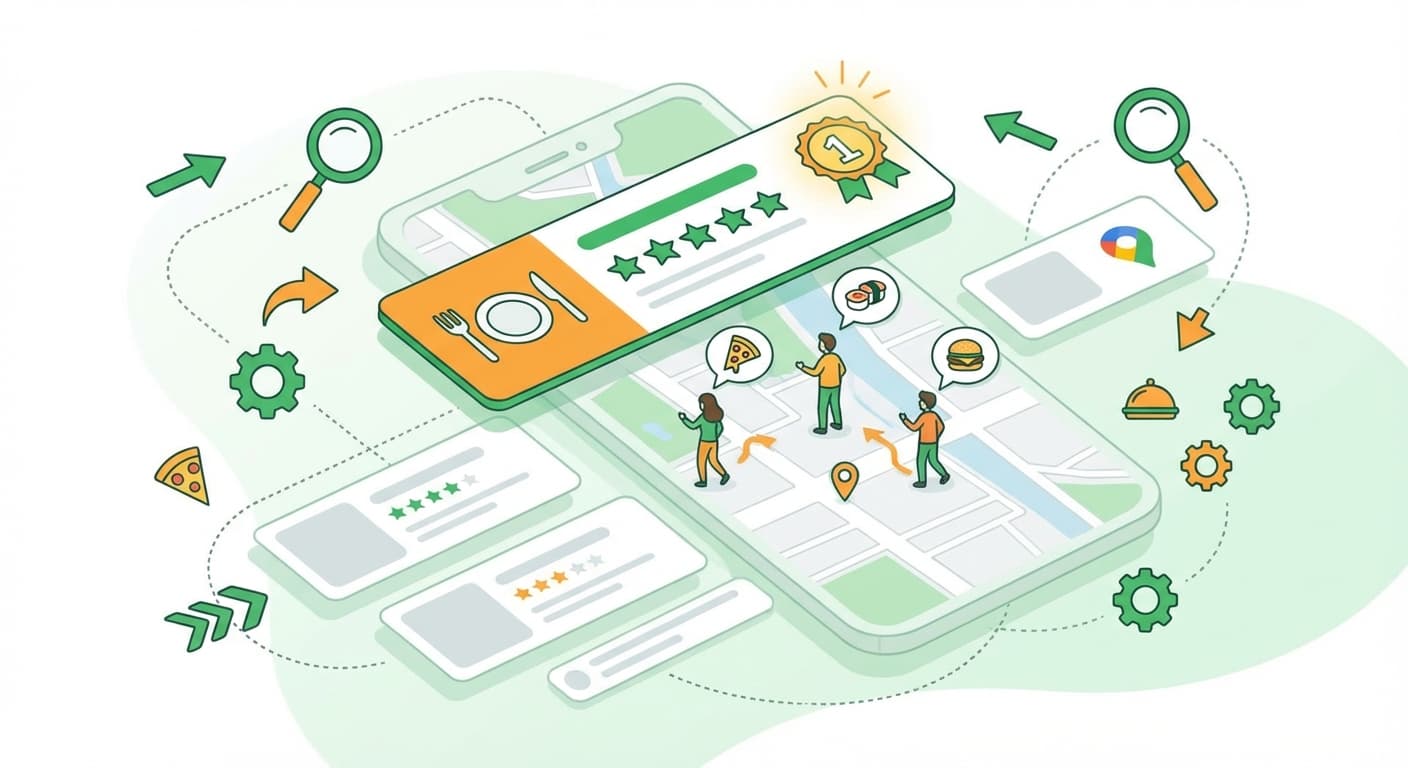
For restaurants especially, Google Maps is often the first place hungry customers look. The "local pack" - those three businesses that show up with a map at the top of search results - drives massive traffic.
Getting into that top three is competitive. Reviews are often the deciding factor. Two restaurants with similar profiles but different review counts? The one with more reviews typically wins.
And once you are in that top three, your click-through rate skyrockets. Searchers rarely scroll past the map pack to look at other options. Position matters enormously.
Keywords in Reviews Boost Relevance
Here is something most businesses do not realize: the text of your reviews can help you rank for specific searches.
When guests mention "amazing brunch" or "best steak in town" or "romantic dinner," those phrases become associated with your business. Over time, this helps you show up for those specific searches.
You cannot (and should not) tell guests what to write. But you can encourage detailed reviews rather than simple star ratings. The more your guests describe their experiences, the more keyword-rich content gets attached to your profile.
Response Signals Engagement
Responding to reviews is not just good customer service. It is an SEO signal.
Google notices when businesses engage with their reviews. Regular, thoughtful responses indicate an active, customer-focused operation. It also gives you another opportunity to include relevant keywords naturally.
Aim to respond to every review, positive and negative. Thank guests for positive feedback. Address concerns in negative reviews professionally. Show that you are paying attention.
Beyond Google: TripAdvisor, Yelp, and More
Google is the biggest player, but it is not the only one. TripAdvisor dominates for hotels. Yelp is still significant for restaurants in many markets. OpenTable reviews matter for higher-end dining.
Each platform has its own algorithm, but the principles are similar. More reviews, better ratings, and recent activity all help you rank higher within each platform's search results.
Plus, reviews on these platforms often show up in Google search results too. A strong TripAdvisor profile can capture clicks from people searching on Google.
Building a Review Generation System
So how do you actually get more reviews flowing consistently? It comes down to three things:
Ask every guest. Not some, not when you remember, but every single one.
Ask at the right time. Shortly after the experience while it is still fresh.
Make it effortless. One tap to leave a review, no hoops to jump through.
Manual processes fail because they depend on busy staff remembering to ask. Automation ensures consistency. Every guest, every visit, every checkout gets the same follow-up.
The Compound Effect
Here is the beautiful thing about review-driven SEO: it compounds over time.
More reviews lead to higher rankings. Higher rankings lead to more visibility. More visibility leads to more guests. More guests leave more reviews. The cycle feeds itself.
Start now and in six months you will have built a significant advantage over competitors who are still neglecting their reviews. Wait, and you will be playing catch-up while they pull further ahead.
Your online reputation is directly tied to your search visibility. Build one and you build the other. That is the simple truth of local SEO for hospitality businesses today.
Ready to Boost Your Reviews?
Join hundreds of businesses using Review Monster to grow their online reputation automatically.
Start Your Free Trial